Needle-Free Treatment for Pain Relief
Shockwave Therapy
Don’t let pain hold you back. Ortho Regenerative offers a fast, non-invasive outpatient treatment that targets the source of your pain and helps your body heal naturally.
Discover how this quick, safe therapy can get you back to the activities you love—without medications or downtime.
What is Shockwave Therapy?
Shockwave therapy, known formally as Extracorporeal Shockwave Therapy (ESWT), uses powerful sound waves to promote healing in damaged tissues. Originally developed in the 1980s to break up kidney stones, this technology has evolved into an effective treatment option for a range of musculoskeletal (joint and connective tissue) conditions.
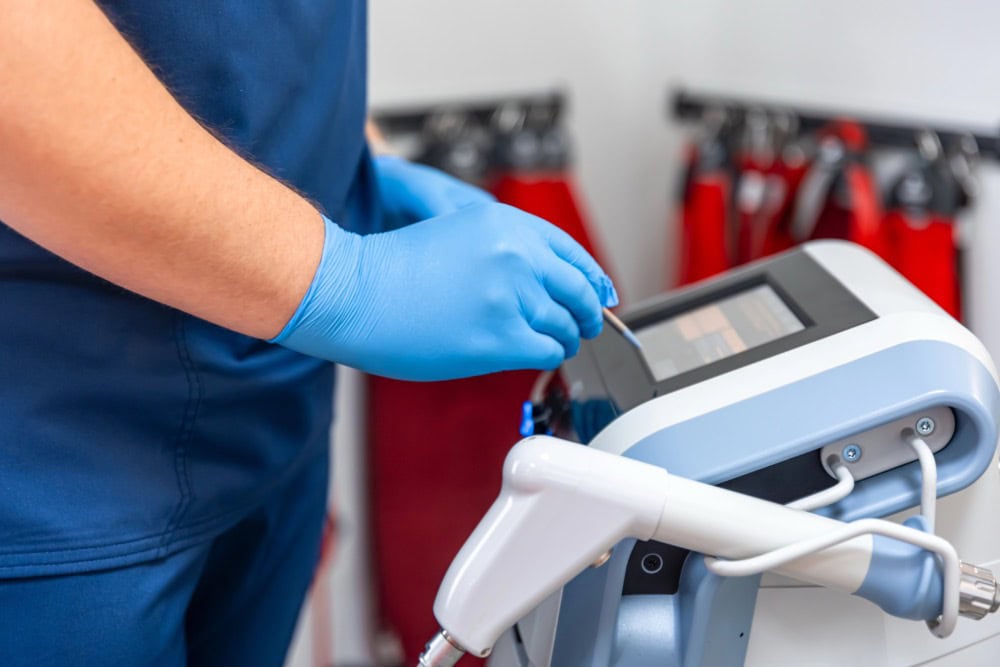
The therapy involves delivering high-energy sound waves through the skin to the affected area using a handheld device. These waves stimulate your body’s natural healing processes by increasing blood flow, promoting the formation of new blood vessels, and triggering the release of growth factors that help repair damaged tissue.
Shockwave therapy works with your body’s own repair mechanisms to address the underlying problem. Because it’s non-invasive, there are no incisions, no need for sedation, and minimal downtime. You can drive home on your own and you do not need any bedrest or special precautions after. You can take all your usual medications as you normally do.
Each treatment session is typically 15-20 minutes and most patients can return to their normal activities immediately.
Benefits of Shockwave Therapy
Research has shown that shockwave therapy promotes the formation of new blood vessels, increases tissue production for tissue repair, and helps reduce pain by influencing local nerve activity and pain receptor sensitivity. The biological effects can continue for several weeks after each treatment session as tissue remodeling takes place.
Clinical studies show that approximately 60–80% of patients with chronic tendon injuries experience meaningful improvement with shockwave therapy.
It is highly effective for tendon and ligament injuries, arthritis in the joints, spine pain, and bone fractures that are not healing properly (non-union fractures).
Shockwave therapy may be particularly valuable for patients who want to avoid or delay surgery, who cannot take anti-inflammatory medications due to other health concerns, or who have tried multiple other treatments without adequate relief.
For patients who are uncomfortable with needles or prefer to avoid injection-based treatments, shockwave therapy provides an effective alternative that doesn’t require repeated injections.
Shockwave is very effective with combined with other regenerative treatments.
What Conditions Can Be Treated?
Foot and Ankle
- plantar fasciitis (heel and arch pain from irritation of the thick band of tissue on the bottom of the foot)
- Achilles tendinopathy (pain and stiffness in the tendon at the back of the heel)
- chronic ankle pain (ongoing ankle soreness or aching, often after sprains or overuse)
- heel spurs (bony growths on the heel bone that can cause sharp heel pain, especially when walking)
Knee
- patellar tendinopathy (jumper’s knee – pain at the front of the knee just below the kneecap)
- chronic knee pain (long-lasting knee ache, stiffness, or soreness from wear-and-tear or old injuries)
- tendon injuries (strains or tears of the tendons around the knee causing pain with movement)
Hip
- trochanteric bursitis (outer hip pain from irritation of the fluid-filled sac on the bony point of the hip)
- gluteal tendinopathies (buttock and outer hip pain from irritated gluteal tendons)
- hip pain from tendon issues (deep or aching pain around the hip from overworked or injured tendons)
Elbow
- lateral epicondylitis (tennis elbow – outer elbow pain from overuse of the forearm muscles)
- medial epicondylitis (golfer’s elbow – inner elbow pain from overuse of the forearm and wrist muscles)
Shoulder
- rotator cuff tendinopathy (shoulder pain and weakness from irritated or worn rotator cuff tendons)
- calcific shoulder tendinopathy (shoulder pain from calcium deposits in the rotator cuff tendons)
- chronic shoulder pain (ongoing shoulder aching or stiffness, often with lifting or reaching)
Back and Spine
- chronic low back pain (long-term lower back ache or stiffness, often worse with certain positions)
- myofascial pain (muscle pain with tight, tender “knots” or bands in the muscles)
- trigger points (small, very tender spots in muscles that can cause pain locally or refer pain elsewhere)
Other Areas
- hamstrings tendinopathy (pain or tightness in the back of the thigh from overworked hamstring tendons)
- various other chronic tendon and soft tissue problems throughout the body (long-lasting aches and pains in muscles, tendons, and ligaments)
- peripheral neuropathy (nerve damage causing numbness, tingling, or burning pain in the feet or hands, often in older adults with diabetes)
- Osgood–Schlatter disease (painful bump below the kneecap in growing kids and teens, especially active athletes)
The Procedure
The procedure itself takes approximately 15–20 minutes per treatment session, with the device delivering several thousand pulses of sound energy depending on the treatment area.
You will likely feel better in the area after the first treatment. Many patients report they feel as if they’ve had a great deep tissue massage to the area. However, it takes 5–6 treatments in a row to see actual healing of your problem, as opposed to just pain relief. Therefore, we only recommend this treatment in a series of 5–6 sessions.
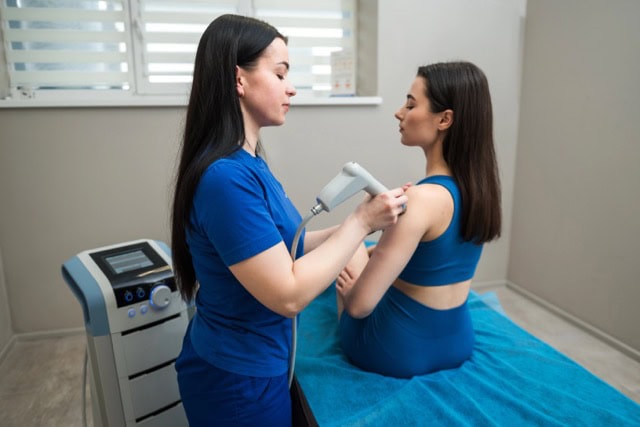
To begin, a member of our clinical team will apply gel to the treatment area, similar to what’s used for an ultrasound. This helps the acoustic waves pass through your skin into the deeper tissues. The shockwave device is then positioned over the affected area, and controlled pulses of sound energy are delivered to the tissue.
The sensation is often described as a tapping or pulsing feeling. However, because treatment time is brief, most people find they can manage any discomfort without numbing medication. The intensity can be adjusted based on your tolerance.
Due to the nature of this treatment, it is extremely safe and virtually no complications have been reported in decades of use over hundreds of thousands of patients.
Forms of Shockwave Therapy
There are two main types of shockwave therapy that may be used:
Focused shockwave therapy delivers concentrated energy to a small, specific area. This is useful for pinpoint problems like calcium deposits in tendons or very localized areas of damage or very deep areas.
Radial shockwave therapy spreads sound waves over a broader area with slightly lower peak energy. This approach is often used for conditions that affect a larger region, such as plantar fasciitis or widespread myofascial pain.
Our clinicians will determine which type of shockwave therapy, or combination of both, is most appropriate for your specific condition based on the location and nature of your problem.
What To Expect After Treatment

Following your shockwave therapy session, you will likely feel immediate pain relief as if you had a good massage to the area. You may resume all normal activity immediately. No special precautions are needed after treatment. No bedrest is recommended.
Most treatment plans involve 5-6 sessions scheduled approximately one week apart. The number of sessions you’ll need depends on your specific condition, how long you’ve had the problem, and how your body responds to the initial treatments.
For most people the benefits develop progressively as tissues heal and regenerate.
Improvement typically begins within 2-4 weeks of starting treatment, with maximum benefit usually achieved by 3-6 months. This pace reflects the biological healing process, as your body needs time to form new blood vessels, produce healing proteins, and rebuild damaged tissue.
FAQ
Compared to cortisone injections specifically, shockwave therapy provides much better long-term results. While cortisone may offer faster initial relief, studies show that shockwave therapy often produces more sustained improvement without the risks associated with repeated steroid injections, such as tendon weakening or rupture. Shockwave therapy actually promotes tissue healing and strengthening, while steroids can weaken tissues with repeated use. Steroids also worsen joint arthritis.
Compared to regenerative injections like platelet-reach plasma (PRP), both treatments work by promoting your body’s healing processes. Shockwave uses purely mechanical energy-based stimulation and does not involve drawing blood or injections. The choice between them depends on your specific condition, your preference regarding injections, and other individual factors. In some cases, Dr. Attaman may recommend combining treatments for optimal results. In fact, when prp and shockwave are combined, the results are synergistic and better than either on their own.
While shockwave therapy is safe for most patients, there are some situations where it should not be used. These include pregnancy, active infections in the treatment area, cancer in the treatment area, treatment over open growth plates in children, areas with metal implants or pacemakers directly in the treatment field, and certain other medical conditions.
We will carefully review your medical history to determine if shockwave therapy is safe and appropriate for you.
Take the First Step Toward
a Pain-Free Life
Shockwave therapy works great for both acute (new) and chronic (old) conditions.
If you wish to avoid physical therapy or months of slow recovery after an acute injury, shockwave is a great option in most cases. If you have a long term condition and you’ve tried physical therapy, activity modification, medications, and other conservative approaches without adequate relief, and you’re looking for an option that avoids repeated injections or surgery, shockwave therapy can help.
We will personally evaluate your condition to determine if shockwave therapy is appropriate for you. He will take time to hear your story, review your previous treatments, and consider all available options.